Lift Rawlett is committed to providing our students with a comprehensive programme of Careers, Education, Information, Advice and Guidance (CEIAG). It is vital that we make sure our students are able to receive the guidance they need to make sensible choices as the move through each stage of their education and onto their chosen career. To enable staff to do this we have invested heavily in the Unifrog Careers Platform to enable a comprehensive careers programme to be delivered to all students.
Mr R Kingstone
Our careers lead Email: rkingstone@liftrawlett.org, Telephone: 01827 57178
Statement of Intent
Introduced as an amendment to the Technical and Further Education Act 2017, the Baker Clause stipulates that schools must allow colleges and training providers access to every student in years 7- 13 to discuss non-academic routes that are available to them. It is expected that by doing so this will help address the UK’s productivity challenges and address skills shortages experienced across several sectors of the economy. This regulation has been enforced since January 2nd 2018.
In line with the Baker Clause we deliver an enhanced careers program to all students throughout their educational journey at Rawlett. Not only do we provide bespoke careers information and guidance for all years but we welcome many of our local colleges and training providers into school to engage with students in a variety of ways.
If you are a post 16 provider please do email our careers leader and/or take a look at ourprovider access policyfor more information.
Many students may leave unsure of their exact career path, however they will leave knowing the following:
Strengths and weaknesses.
How to use a range of up to date resources to help research suitable careers, ideas and decision making.
Help with interpreting career information.
One to one support to help explore career ideas and gain confidence.
Ongoing sessions to improve skills e.g. CV and cover writing, interview techniques and what to do next.
As an Academy we endeavour working towards three core documents :
Careers and work related education is an important part of the wider curriculum that we offer within the academy to our students.
We believe that every individual should be prepared for the opportunities, responsibilities and experiences of adult life, and that this preparation should be an important and distinctive element of the curriculum.
If you are interested in working in partnership with us or keen to offer opportunities to our students or academy, please contact our Mr Kingstone, rkingstone@liftrawlett.org, our SLT Careers Lead.
As Lift Rawlett does not have the option of staying on for post 16 qualifications, students will need to consider applying to another school for 6th form, college or apprenticeship. It is important that our students give themselves enough time to think about this, it is never to early to start to think about your options and chosen career path.
Careers Education and Guidance Programme Statement
Lift Rawlett is committed to providing our students with a comprehensive programme of careers education, information, advice and guidance (CEIAG) and work related learning (WRL) for all students in years 7-11.
Careers and work related education is an important part of the wider curriculum that we offer within the academy to our students.
We believe that every individual should be prepared for the opportunities, responsibilities and experiences of adult life, and that this preparation should be an important and distinctive element of the curriculum.
Our Careers Education Programme provides students with skills, knowledge, support and experience of the world of work to enable them to make informed career choices.
Another important element for our students is the access to independent and impartial advice and guidance, which supports them in broadening their horizons, raising aspirations and reaching their own careers aspirations.
This information has been pulled together in one place so that students and parents can access the information easily to assist the reader.
As highlighted above students will be making important pathway and career choices which will ultimately impact on their life. It is essential that parents and carers play an active role in exploring the options and choices which are best for their child.
Below is an overview of CEIAG.
Qualifications and Assessments
What are GCSE's?
GCSE - stands for General Certificate of Secondary Education. GCSE examinations are taken by most pupils at the end of compulsory school education (year 11) in England, Wales and Northern Ireland.
GCSE's
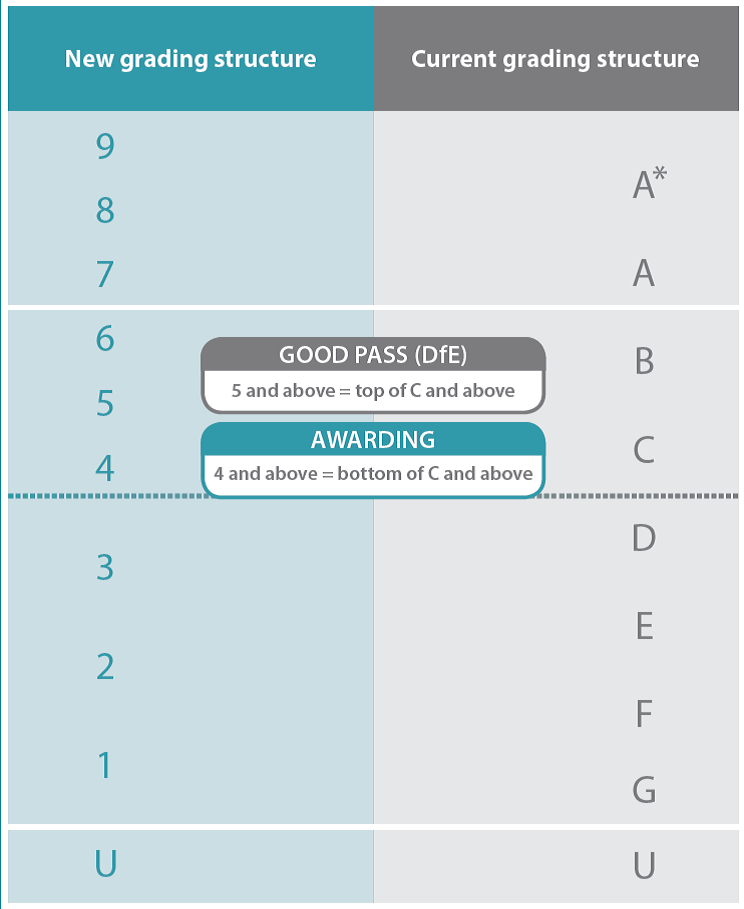
These are the main qualifications at Key Stage 4. They are graded A* to G in some subject areas, but the vast majority are now graded 1-9 as per the new GCSE grading structure, (more details under assessment changes).
The expectation is that any student working at grade 4-5 in a subject in Year 9 should go on to gain a grade C equivalent in the subject at GCSE. GCSEs are assessed by externally set written examinations and controlled internal assessments.
Level 2 BTEC Award and Extended Certificates.
These are courses linked to vocational areas. They have practical based elements and most marks come from a portfolio of coursework and assignments, which assess how well the student can demonstrate the skills and understanding that they have developed. These are currently awarded at one of the following grades, Distinction *, Distinction, Merit and Pass, and have a GCSE equivalence.
TLM Information Technology and Computing Awards.
These are computing or IT qualifications that are assessed through a portfolio of work to demonstrate what you can do to pass the qualification. There Is an external exam for the level 2 course.
Assessment changes.
Over the next few years, new, tougher GCSEs will be introduced; firstly in English and Maths, then in most other subjects the following year. This is the same for all schools in the country. The new GCSEs will be graded on a scale from 9 - 1.
The new system does not mirror the old letter grade system of the current GCSEs. However, the new grade 4 is in-line with the current grade C, and the new grade 7 is in-line with the current grade A. It is expected that the new grade 9 will be awarded to the top 20% of students who presently achieve grades A and A* in current GCSEs.
The table below compares the current and the new GCSE grading structure.
Further Education after GCSE's
Sixth Form Opportunities
Moving on to 6th Form
As Lift Rawlett does not have the option of staying on Post-16, you may want to consider applying to another school. It is worth giving yourself time to think about this, and start looking into attending some open days/evenings at your chosen institution. This will allow you to get a feel for whether you would be comfortable there, as being happy in your surroundings is important.
What will you study?
You may have already decided on what subjects you would like to study, most 6th forms offer AS/A levels and BTEC Diplomas. These are usually a continuation of what you have selected in your GCSE options, e.g. History and Art. Some 6th forms may offer a wider range of choices like vocational qualifications.
What will it be like there?
6th form will be more relaxed, but still remain structured like at The Rawlett School. You will get times where you will not have a lesson, this is called a ‘free period’. You are expected to use this time to continue with your studies or complete outstanding homework. This time is not supervised by a teacher and if you are lucky, your school will have a room where 6th formers can go.
Even though you may have a free period, your school WILL expect you to still attend for the day. You will also not have to wear a school uniform, but follow a smarter dress code. Sorry no Jeans!!
How can I find out more?
If you are still unsure as to whether 6th form is for you, here’s some things you can start doing now:
Start attending 6th form open days/evening - make sure you visit a few institutions; this will help you to confirm that you’ve made the right choice.
Talk to students that already attend 6th form.
Talk to the teachers - especially the ones that will be teaching you if you go there.
Make sure that the 6th offers the courses you want to do.
Start talking to people you trust, who can offer advice - parents, teachers or careers adviser.
Please click the following video advice from UCAS on preparing for Post 16.
Please see the local 6th form opportunities that are available to you:
As Lift Rawlett does not have the option of staying on Post-16, you may want to consider applying to college. It is worth giving yourself time to think about this, and start looking into attending some open days/evenings at your chosen institution. This will allow you to get a feel for whether you would be comfortable there, as being happy in your surroundings is important.
What is it like there?
College environment is more laid back then 6th form and school. You are allowed to wear your own clothes and you are responsible for your time keeping. Some tutors will also let you call them by their first names, no more Sir or Miss!
You will still have a structured timetable to follow and the college will expect you to attend all classes, and if you have any free periods you will not be expected to stay on site.
Word of warning - you will be given a lot more independence and will be responsible for yourself and your learning. If you are not the type of person that is good at getting into class of on your own, being more organised and dedicated to your learning this option may be right for you. If you need structure in your learning, 6th form is advisable.
How can I find out more?
If you are still unsure about whether attending college is right for you, here’s some things you can start doing now:
Start attending college open days/evening - make sure you visit a few institutions; this will help you to confirm that you’ve made the right choice.
Talk to current students that already attend college.
Talk to the lecturers - especially the ones that will be teaching you on your course.
Check you meet the entry requirements.
Make sure the college offers the course you want.
Start talking to people you trust, who can offer advice - parents, teachers or careers adviser.
Please click the following video advice from UCAS on preparing for Post 16.
Please see the local college opportunities that are available to you:
As Lift Rawlett does not have the option of staying on Post-16, you may want to consider applying for an Apprenticeship. It is worth giving yourself time to think about this, and start looking into attending some open days/evenings at your chosen institution. This will allow you to get a feel for whether you would be comfortable there, as being happy in your surroundings is important.
Apprenticeships
Apprenticeships are a great way to learn on the job, but also earn some money. On apprenticeships you are employed on a real job, trained and once qualified receive a nationally recognised qualification. Even though the age of leaving school has gone up to 18 years old, you can leave at 16 to pursue a career where you are trained whilst working. This means you will need to decide on what you want to do before some of your friends, as competition for apprenticeship are competitive. But don’t let that put you off.
What is an Apprenticeship?
As mentioned above, an apprenticeship is a great way to earn while you learn. If you are successful in gaining a place on an apprenticeship, your employer will pay your wages whilst give you training on the job. You will work alongside qualified professionals who will provide you with guidance, support and help you learn the job to the best of your ability.
Your apprenticeship provider will expect you to attend either college, university or a different training institution one day a week known as ‘day release’ to complete your studies then return back to work for the rest of the week.
What qualifications will I get?
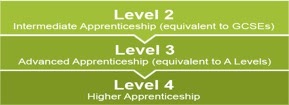
Your work based learning will be marked in three stages:
Who can take an apprenticeship?
To apply for an apprenticeship, you need to be over 16 years old and depending on the level which you want to apply for, you will be required to have passed your Math’s and English.
What experience will I need?
You must have the following:
Have finished school/college
Be confident you have the skills to achieve your apprenticeship
How long will it last?
Your apprenticeship can last from one year up to four.
How much can you earn?
The minimum wage per hour you can earn is £3.30, but most employers may pay more - the average is £170 per week. (This figure varies depending on the employer).
How much will it cost?
Apprenticeships cost nothing! If you are under 24 years old.
What types of Apprenticeships are there?
Apprenticeships are no longer just engineering or construction, you can now into 170 industries with 1400 different jobs e.g. trainee accountant, dental nurse, mechanic.
Please see the local college opportunities that are available to you:
If you are 16-18 years old you are entitled to find a job. However as a young worker there are rules that apply to ensure that you are kept safe and work in age appropriate environments.
Please ensure that you talk to your parents/carer about your employment aspirations to ensure that they are aware of this and that they are okay with your choices.
For full information on the rules about employment of young workers please click this link here
Labour Market Information (LMI)
Labour market information can help you make a good decision when you are exploring a career path, want to change jobs or move to a new place. It can help you find out what the labour market is like for that job or that city. For example, if you were interested in becoming a nurse or doctor and you move to a town where there is not a local hospital, you will have a hard time finding a job.
Labour market information tells you:
· What jobs and skills employers are looking for
· Which industries are hiring and where they are located
· Where to find employers who are hiring
· What education and training you need for specific jobs
· Which job areas are growing in the future and other statistics
Use the Careerometer to find out about a career of interest to you!
Youth Volunteering
Volunteering is a great way of getting experience, giving something back and helps with work related learning including working in a team, communication and working under pressure.
Having these skills and experiences can be really helpful on a personal statement or your CV. VInsipred is a national organisation that has many youth volunteering opportunities.
Please click on the link below to find out more about the benefits and opportunities of volunteering.
Let's Talk Futures
Welcome to AET's ‘Let’s Talk Futures’ - a one stop shop for parents / carers looking to support their children as they make important decisions about their future pathways.
As parents, carers and guardians, you are the biggest influencer of your young person's decisions about their next steps, their qualification choices, their place of study and ultimately their career choice. As parents it is not always easy to know where to find the latest information, what questions to ask or what advice to give. Hopefully this website, the supporting guides, resources and signposting to useful links will help you to support your child to make informed decisions and turn their aspirations into reality.
Do Together Tasks - click on the image below to access
We have created a series of short tasks and activities that you might like to use with your child when discussing careers at home. The resource is designed to help you instigate purposeful career conversations and includes things like key questions you might like to ask, discussion prompts you can use, short activities that you can set and links to resources and websites that you can explore together.
‘Thinking about the future’
A short and informal live webinar session for KS3 parents and their children. The session will be in the format of a panel discussion and will include experts such as careers advisers and recruitment specialists. You will have opportunities to submit questions during the session via the chat facility and panellists will do their best to respond to these. The discussion will cover the skills employers look for, the jobs market of tomorrow, the range of progression routes available and considerations when choosing KS4 options. The webinar will be recorded and posted on this page so that you can watch it back should you wish to.
Please fill in the form below to register and you will be sent a link to join the event.
A webinar for KS4 parents and their children: The webinar will cover qualifications, progression routes and ‘choosing the right pathway for me’. This will be targeted at Y10 and Y11 parents.
Please fill in the form below to register and you will be sent a link to join the event.
Here at The Rawlett School, we aim to deliver a broad and balanced curriculum that will meet the needs of all our students and allow them to follow the appropriate pathway for the development into a future area of study and onto their chosen career.
We take the process of choosing options very seriously and our aim is that all students and their parents, should be provided with enough information to make informed choices about their future. The Pathway Guide (Pleaseclick here to view the KS4 Options Booklet) is the key source of information available to all, to assist in making the transition process run as smoothly as possible. The school also holds an 'Options Evening' which would be beneficial for you to attend, as this will provide the opportunity to have the whole process explained in greater detail, enabling you to have empowered knowledge in supporting your son/daughter to make the correct choices.
Personalised advice and guidance will be provided by Heads of House and Senior Leaders, so please do not hesitate to make contact with them as they are here to support you and provide guidance through the pathway process.
Once all option slips have been returned, checked and approved we will then start work on constructing the Key Stage 4 timetable for the next academic year. Occasionally, it may be necessary for some students to make alternative choices as some subject combinations may prove to be impossible e.g. some class sizes may be too small or because there is a clash with subjects being taught at the same time.
If this happens we will endeavour to explain the issues promptly and assist in providing additional support to select alternatives. It is fundamental that students take the time to discuss with teachers their choice of optional subjects. Once the student has then commenced the KS4 pathway there will be no option to change, so it is VITAL that all students choose their options carefully and discuss with staff the content of the courses on offer.
CEIAG for Key Stage 3
Key Stage 3 (commonly abbreviated as KS3) is the legal term for the three years of schooling in maintained schools in England and Wales normally known as Year 7, Year 8 and Year 9, when pupils are aged between 11 and 14.
The Rawlett School will offer the following careers support and guidance for all students within KS3. They will all receive the following:
Curriculum support in all subjects promoting related job advice.
Allotted time through ‘Tutor Time’ for self-development focusing on lifestyle and progression.
Access to the careers etc software during Tutor Time.
Year 9 will be invited to attend a Pre-Options Evening.
Assemblies and other information on KS4 options including vocational and alternative courses.
Enrichment and Enterprise activities take place on Curriculum days and in tutor time.
By the end of KS3 all students will have:
A better understanding of their strengths, achievements and weaknesses and support to evaluate how these might inform future choices in learning and work.
A better understanding of the full range of 14-19 opportunities for progression.
An understanding of some of the qualities, attitudes and skills needed for employability.
Used online careers resources to research information about opportunities and apply their findings to help make informed choices for Key Stage 4 options.
Received appropriate advice and guidance on Key Stage 4 options and prepared an individual learning plan that sets broad learning goals.
CEIAG for Key Stage 4
Key Stage 4 is the legal term for the two years of school education which incorporate GCSEs, and other exams, in maintained schools in England normally known as Year 10 and Year 11, when pupils are aged between 14 and 16.
The Rawlett School will offer the following careers support and guidance for all students within KS4. They will all receive the following:
Consider undertaking a One week block work experience placement which focuses on students’ future career aspirations, where possible, allowing learning about work through the experience of work.
Careers Fair in school day.
College presentations.
Careers Interview for every Year 11 student.
Information on College ‘Open Days’.
Support when completing College Application forms.
Mock Interviews.
Supported CV and Personal Statement sessions within English curriculum.
Close monitoring of vulnerable students.
By the end of Key stage 4, all students will have:
Enhanced their self-knowledge, career management and employability skills.
Used ICT software and other sources of advice to investigate and explore future choices and progression routes.
Considered the value of gaining experience of the ‘World of Work’ through a placement if they require one (first 2 weeks in July).
Been given direct access to employers, colleges and training providers.
Been given guidance to help identify a range of post-16 options and careers advice.
Been provided with the resources to complete the post-16 application process, including CV’s, personal statements, and preparation for interview.
Been given information about appropriate available funding
Produced a challenging but realistic plan for their future learning and work, by relating their abilities, attributes and achievements to the goals they have set themselves.
University is a pathway that takes place after year 13 where most students study for a degree. It is also the first step into Higher Education.
A degree is usually a three or four year course – also known as a bachelor's, undergraduate or first degree. Universities are dynamic academic environments with lectures and seminars, usually made up of different modules adding up to the full degree.
Please see the video below, this will give a break down of things you may want to consider when preparing for Higher Education.
You might get to choose some of the modules you take, so you'll be able to study the parts of your subject you're most interested in.
Two subjects? Take a joint course (50/50) or a major/minor (75/25).
Work experience? Do a sandwich course and work for a year in the industry your subject is based on.
What next? After you graduate you'll be closer to a career, or you can move on to postgraduate study.
It is very important that you meet the criteria to be able to apply for the subject/area that you want to study and the university that you want to apply to. This is where pre planning and talking through your career aspirations with an adult becomes important so that you choose the right options in earlier key stages.
There are other shorter undergraduate courses.
These are ideal if you want a quicker qualification. Do one year of a degree – a Certificate of Higher Education (CertHE) – or two years – a Diploma of Higher Education (DipHE), Higher National Diploma (HND) or Foundation degree.
These don't lead directly to postgraduate study, but you can go into the second or third year of a full degree if you change your mind and want to graduate after all.
UCAS (Universities and Colleges Admissions Service)
UCAS is the organisation that is responsible for managing applications to higher education courses in the UK. UCAS stands for the 'Universities and Colleges Admissions Service'. Their aim is to help students make informed choices that are right for them, guiding them, as well as their parents and advisers, through the entire higher education application process.
Today, UCAS processes over 2.5 million applications every year, for some 650,000 prospective students across the UK and beyond: helping them gain access to more than 340 UK universities and colleges.
Please see the video below, this will give a break down of things you may want to consider when preparing for Higher Education.
Please use the link to find out more about UCAS and how they can assist you.
What is a BA, BEd and BSc?
Each of the above acronyms are related to a bachelor degree which is the first degree that you study after school.
BA = Bachelor of Arts
BEd = Bachelor of Education
BSc = Bachelor of Science
What if I do not want to attend university?
University is not for everybody. There are many pathways and options that you can choose if you decide not to go to university. These include an apprenticeship, training, technical college, employment or establishing your own business. A good starting point is to talk about your interests with your parents/carers, family members, teachers and career advisors.
If there are any questions that have been unanswered, please do not hesitate to contact Your Careers Advisor.
In previous years you were allowed leave school at the age of 16, but in 2013 the age was raised to 18. It is a requirement made by the Government that all children in this age range must stay in some form of education or training. In doing this, it enables you to gain more skills and options for the future.
As The Rawlett School does not have the opportunity to continue your studies with us Post-16, you will be required to retake your failed subject at your next chosen institution. It would be important to talk your options through with your parents/carers, teacher or careers advisor they will be to help you explore your next steps.
Key Stage 3 - (Yr8) students will make decisions about the GCSE options for KS4 (Yr10 & 11).
Key Stage 4 - (Yr11) students will make decisions about the post 16 options including A level, BTEC and college options for KS5 (Yr12 & 13).
Key Stage 5 - students will make decisions about the post 18 options including whether to attend university, apply for an apprenticeship, gain employment or take up a training opportunity.
This is perfectly normal and often our career ideas change throughout our lifetime. Do not panic, it is important to talk to somebody and there are lots of staff within the School who will provide you with support and guidance. A good starting point is to talk about your interests with your parents/carers, career advisor, family members, teachers and friends.
Yes, at The Rawlett School we offer the opportunity to go out for one week in July for Year 10 students during Summer Term. This is an important opportunity for students to engage with employers and to find out what the work environment is really like. Students are encouraged to find their own placements that meet their career aspiration.
A Plan B is a backup plan. It is important to have a plan B so that if everything does not go to your first plan (plan A), then you already have a good idea on what you can do. This can help reduce stress, concern and upset.
AS and A levels are the traditional qualifications offered by schools and colleges for 16-19 year olds. They’re highly valued by universities and employers and focus on academic subjects, although some are work-related.
AS levels can be taken as a stand-alone qualification, or as the first part of an A level course. AS levels are completed at the end of Year 12 (the old ‘Lower Sixth’ year). A2 exams and coursework are added on to an AS level at the end of Year 13 (the old ‘Upper Sixth’ year), bringing it up to A level standard.
Apprenticeships you are employed on a real job, trained and once qualified receive a nationally recognised qualification. Even though the age of leaving school has gone up to 18 years old, you can leave at 16 to pursue a career where you are trained whilst working. This means you will need to decide on what you want to do before some of your friends, as competition for apprenticeship are competitive.





.jpg)


.png)